ABSTRACT
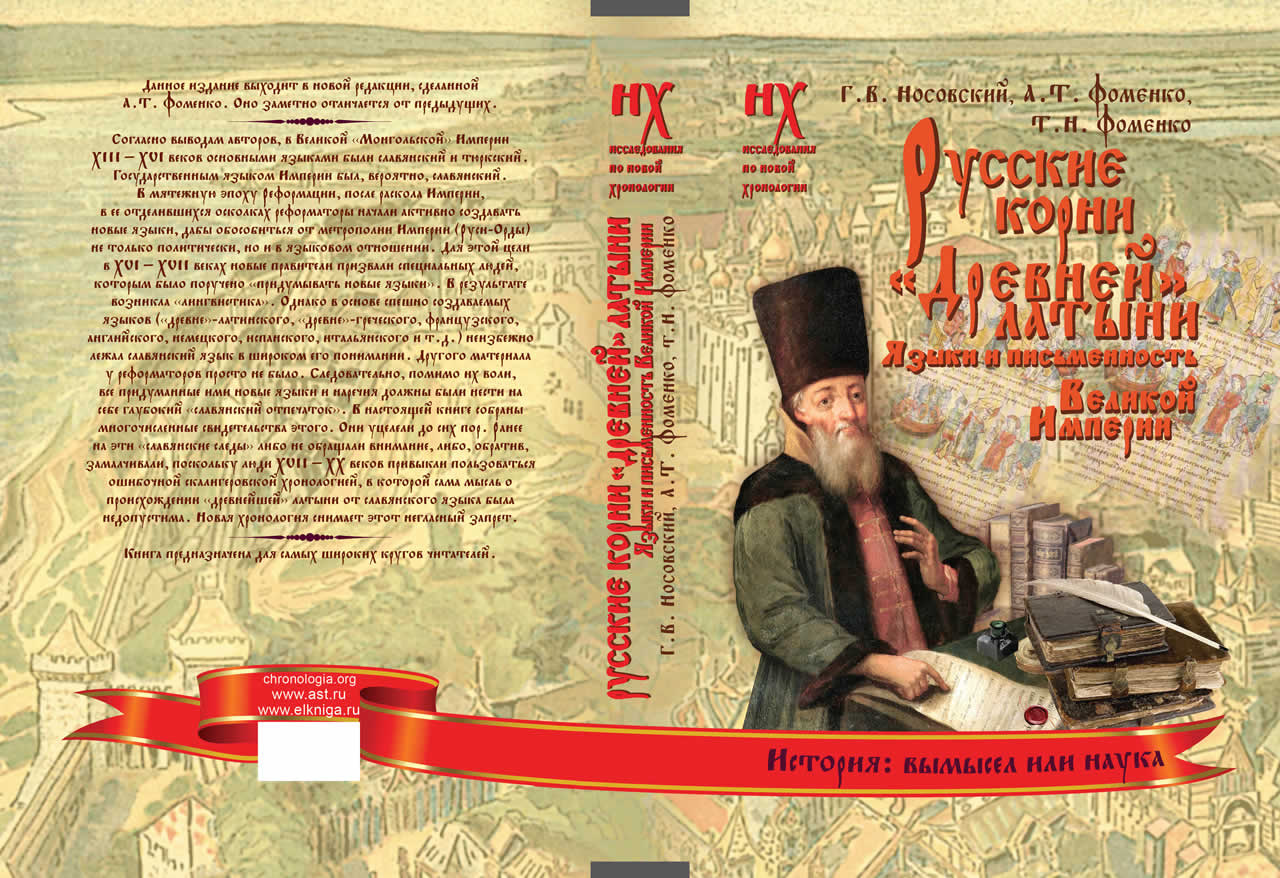
According to the results of authors, in the Great = "Mongol" Empire of the XIII-XVI centuries the main languages were Slavonic and Turkic. Probably Slavonic was a state language of the Empire. At the rebellious epoch of Reformation, after the split of Empire, in its separated fractions, reformers actively started to create new languages, in order to separate themselves from the mother country of the Empire (Russia-Horde) not only politically, but also in a language relation. For this purpose in the XVI-XVII centuries new governors engaged special people, who had to "create new languages". As a result appeared "linguistics". But at the base of quickly created languages ("ancient"-Latin, "ancient"-Greek, French, English, German, Spanish, Italian etc.) inevitably lay Slavonic in its general understanding. Reformers simply didn't have any other material. Consequently, except their will, all the invented by them new languages and dialects should have bear deep "Slavonic stamp". In the present book many evidences of this are collected. They remained until now. Earlier nobody paid attention to these "Slavonic traces", or, having paid attention, hided this, as people of the XVII-XX centuries are accustomed to use a wrong Scaligerian chronology, in which a thought about the origin of the "ancient" Latin from the Slavonic language was not acceptable. New chronology puts off this unspoken prohibition.
The book is aimed for the widest circles of readers.
CONTENTS
A method of search of correspondences between different languages: to find words, sounding similarly, and, at the same time, close in sense.
1. INTRODUCTION. We find close sense and close sounding.
2. A short dictionary of parallelisms. The first, main part.
2.1. Family ties.
2.2. Numerals.
2.3. Pronouns and particles.
2.4. General part.
3. A short dictionary of parallelisms. The second part: less reliable parallels. 3.1. Family links.
3.2. Pronouns and particles.
3.3. General part.
4. Winged Latin words and expressions.
5. Additional observations.
6. A table of discovered most frequent transmissions of consonants.
7. Linguistic parallels, provided by N.�.Karamzin, agree with our result about the origin of the "ancient"-Latin and Greek languages from the Slavonic.
8. Several additions.
LITERATURE.
ABOUT THE AUTHORS.
